In a Recursive Function the Statement S That Invoke the Function Again Are Called the
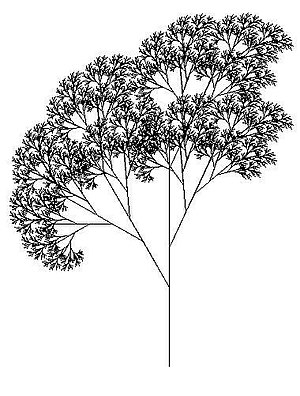
Tree created using the Logo programming language and relying heavily on recursion. Each co-operative can be seen every bit a smaller version of a tree.
In computer science, recursion is a method of solving a computational trouble where the solution depends on solutions to smaller instances of the same trouble.[1] [2]Recursion solves such recursive problems by using functions that telephone call themselves from inside their own lawmaking. The approach tin can exist applied to many types of problems, and recursion is one of the cardinal ideas of informatics.[three]
The power of recursion evidently lies in the possibility of defining an infinite set of objects by a finite statement. In the aforementioned style, an infinite number of computations can be described by a finite recursive program, even if this program contains no explicit repetitions.
—Niklaus Wirth, Algorithms + Information Structures = Programs, 1976[four]
Most computer programming languages back up recursion by allowing a function to call itself from within its own code. Some functional programming languages (for instance, Clojure)[5] do not define any looping constructs merely rely solely on recursion to repeatedly phone call code. It is proved in computability theory that these recursive-simply languages are Turing complete; this means that they are as powerful (they can exist used to solve the same problems) as imperative languages based on control structures such as while and for.
Repeatedly calling a function from inside itself may cause the call stack to have a size equal to the sum of the input sizes of all involved calls. Information technology follows that, for problems that can exist solved easily by iteration, recursion is generally less efficient, and, for large problems, it is central to utilize optimization techniques such as tail call optimization.[ citation needed ]
Recursive functions and algorithms [edit]
A common algorithm design tactic is to divide a problem into sub-bug of the same type as the original, solve those sub-bug, and combine the results. This is often referred to equally the carve up-and-conquer method; when combined with a lookup tabular array that stores the results of previously solved sub-problems (to avoid solving them repeatedly and incurring extra computation time), it can exist referred to as dynamic programming or memoization.
Base example [edit]
A recursive role definition has one or more base cases, meaning input(s) for which the function produces a result trivially (without recurring), and one or more recursive cases, meaning input(s) for which the plan recurs (calls itself). For case, the factorial function tin can be divers recursively by the equations 0! = i and, for all due north > 0, n! = n(n − one)!. Neither equation by itself constitutes a consummate definition; the first is the base of operations case, and the 2d is the recursive instance. Because the base case breaks the chain of recursion, it is sometimes besides chosen the "terminating case".
The task of the recursive cases tin can be seen as breaking down complex inputs into simpler ones. In a properly designed recursive function, with each recursive phone call, the input problem must be simplified in such a way that eventually the base case must be reached. (Functions that are not intended to terminate nether normal circumstances—for example, some system and server processes—are an exception to this.) Neglecting to write a base case, or testing for it incorrectly, can cause an infinite loop.
For some functions (such as one that computes the serial for e = one/0! + i/1! + ane/2! + 1/iii! + ...) there is non an obvious base case implied by the input data; for these one may add a parameter (such every bit the number of terms to be added, in our series example) to provide a 'stopping benchmark' that establishes the base example. Such an example is more naturally treated by corecursion,[ how? ] where successive terms in the output are the partial sums; this can be converted to a recursion past using the indexing parameter to say "compute the nth term (northth partial sum)".
Recursive data types [edit]
Many calculator programs must process or generate an arbitrarily big quantity of data. Recursion is a technique for representing data whose exact size is unknown to the programmer: the programmer can specify this data with a self-referential definition. There are two types of cocky-referential definitions: inductive and coinductive definitions.
Inductively divers data [edit]
An inductively defined recursive data definition is ane that specifies how to construct instances of the data. For example, linked lists can be defined inductively (here, using Haskell syntax):
information ListOfStrings = EmptyList | Cons Cord ListOfStrings The code above specifies a list of strings to be either empty, or a construction that contains a string and a listing of strings. The cocky-reference in the definition permits the structure of lists of whatsoever (finite) number of strings.
Another example of inductive definition is the natural numbers (or positive integers):
A natural number is either i or n+1, where n is a natural number.
Similarly recursive definitions are often used to model the structure of expressions and statements in programming languages. Linguistic communication designers often express grammars in a syntax such as Backus–Naur form; here is such a grammar, for a elementary linguistic communication of arithmetic expressions with multiplication and addition:
< expr > ::= < number > | (< expr > * < expr >) | (< expr > + < expr >) This says that an expression is either a number, a product of two expressions, or a sum of two expressions. By recursively referring to expressions in the second and third lines, the grammar permits arbitrarily complicated arithmetic expressions such as (v * ((iii * 6) + eight)), with more than than one product or sum operation in a single expression.
Coinductively defined data and corecursion [edit]
A coinductive data definition is one that specifies the operations that may exist performed on a piece of data; typically, self-referential coinductive definitions are used for data structures of infinite size.
A coinductive definition of infinite streams of strings, given informally, might look like this:
A stream of strings is an object south such that: head(s) is a string, and tail(s) is a stream of strings.
This is very like to an anterior definition of lists of strings; the difference is that this definition specifies how to access the contents of the data structure—namely, via the accessor functions head and tail—and what those contents may be, whereas the anterior definition specifies how to create the construction and what it may be created from.
Corecursion is related to coinduction, and tin be used to compute particular instances of (maybe) infinite objects. As a programming technique, it is used near frequently in the context of lazy programming languages, and can exist preferable to recursion when the desired size or precision of a program'southward output is unknown. In such cases the program requires both a definition for an infinitely large (or infinitely precise) result, and a mechanism for taking a finite portion of that result. The trouble of computing the get-go n prime number numbers is one that can be solved with a corecursive program (east.one thousand. here).
Types of recursion [edit]
Single recursion and multiple recursion [edit]
Recursion that contains only a single self-reference is known as unmarried recursion , while recursion that contains multiple cocky-references is known as multiple recursion . Standard examples of single recursion include list traversal, such as in a linear search, or computing the factorial function, while standard examples of multiple recursion include tree traversal, such as in a depth-beginning search.
Single recursion is often much more than efficient than multiple recursion, and tin can generally be replaced by an iterative ciphering, running in linear fourth dimension and requiring constant space. Multiple recursion, by dissimilarity, may require exponential fourth dimension and space, and is more fundamentally recursive, not being able to be replaced past iteration without an explicit stack.
Multiple recursion tin can sometimes be converted to single recursion (and, if desired, thence to iteration). For example, while computing the Fibonacci sequence naively entails multiple iteration, every bit each value requires 2 previous values, it can be computed by single recursion past passing two successive values as parameters. This is more naturally framed as corecursion, building upwards from the initial values, while tracking two successive values at each step – see corecursion: examples. A more sophisticated case involves using a threaded binary tree, which allows iterative tree traversal, rather than multiple recursion.
Indirect recursion [edit]
Most basic examples of recursion, and most of the examples presented here, demonstrate direct recursion, in which a function calls itself. Indirect recursion occurs when a function is called not by itself but past another function that it chosen (either directly or indirectly). For case, if f calls f, that is directly recursion, but if f calls k which calls f, then that is indirect recursion of f. Chains of 3 or more functions are possible; for example, part 1 calls function two, function 2 calls part 3, and function 3 calls function 1 again.
Indirect recursion is also called mutual recursion, which is a more symmetric term, though this is simply a divergence of emphasis, not a different notion. That is, if f calls grand and and then g calls f, which in plough calls g once more, from the point of view of f solitary, f is indirectly recursing, while from the point of view of g alone, it is indirectly recursing, while from the point of view of both, f and g are mutually recursing on each other. Similarly a set of 3 or more functions that call each other can be called a ready of mutually recursive functions.
Anonymous recursion [edit]
Recursion is unremarkably done by explicitly calling a function by name. However, recursion can also be washed via implicitly calling a function based on the current context, which is particularly useful for bearding functions, and is known as anonymous recursion.
Structural versus generative recursion [edit]
Some authors classify recursion as either "structural" or "generative". The distinction is related to where a recursive process gets the information that it works on, and how it processes that information:
[Functions that consume structured data] typically decompose their arguments into their firsthand structural components and so process those components. If one of the immediate components belongs to the aforementioned form of data as the input, the role is recursive. For that reason, we refer to these functions as (STRUCTURALLY) RECURSIVE FUNCTIONS.
Thus, the defining feature of a structurally recursive function is that the argument to each recursive phone call is the content of a field of the original input. Structural recursion includes nearly all tree traversals, including XML processing, binary tree cosmos and search, etc. By considering the algebraic structure of the natural numbers (that is, a natural number is either zero or the successor of a natural number), functions such equally factorial may too be regarded every bit structural recursion.
Generative recursion is the alternative:
Many well-known recursive algorithms generate an entirely new piece of data from the given data and recur on information technology. HtDP (How to Design Programs) refers to this kind equally generative recursion. Examples of generative recursion include: gcd, quicksort, binary search, mergesort, Newton's method, fractals, and adaptive integration.
—Matthias Felleisen, Advanced Functional Programming, 2002[seven]
This distinction is important in proving termination of a office.
- All structurally recursive functions on finite (inductively defined) data structures can hands exist shown to terminate, via structural induction: intuitively, each recursive call receives a smaller piece of input data, until a base of operations instance is reached.
- Generatively recursive functions, in dissimilarity, do non necessarily feed smaller input to their recursive calls, and so proof of their termination is not necessarily as unproblematic, and avoiding infinite loops requires greater care. These generatively recursive functions can ofttimes exist interpreted as corecursive functions – each footstep generates the new data, such every bit successive approximation in Newton'southward method – and terminating this corecursion requires that the data somewhen satisfy some condition, which is not necessarily guaranteed.
- In terms of loop variants, structural recursion is when there is an obvious loop variant, namely size or complexity, which starts off finite and decreases at each recursive stride.
- By contrast, generative recursion is when there is not such an obvious loop variant, and termination depends on a function, such equally "error of approximation" that does not necessarily subtract to zero, and thus termination is not guaranteed without farther analysis.
Implementation issues [edit]
In bodily implementation, rather than a pure recursive function (single check for base example, otherwise recursive pace), a number of modifications may be made, for purposes of clarity or efficiency. These include:
- Wrapper role (at top)
- Short-circuiting the base example, aka "Arm's-length recursion" (at bottom)
- Hybrid algorithm (at bottom) – switching to a unlike algorithm one time data is modest plenty
On the basis of elegance, wrapper functions are generally approved, while short-circuiting the base example is frowned upon, particularly in academia. Hybrid algorithms are often used for efficiency, to reduce the overhead of recursion in minor cases, and arm's-length recursion is a special instance of this.
Wrapper function [edit]
A wrapper part is a function that is directly called but does non recurse itself, instead calling a separate auxiliary function which actually does the recursion.
Wrapper functions can be used to validate parameters (so the recursive role tin can skip these), perform initialization (allocate memory, initialize variables), particularly for auxiliary variables such equally "level of recursion" or partial computations for memoization, and handle exceptions and errors. In languages that support nested functions, the auxiliary function can be nested inside the wrapper function and use a shared scope. In the absenteeism of nested functions, auxiliary functions are instead a carve up part, if possible private (as they are non called directly), and information is shared with the wrapper function past using pass-by-reference.
Brusque-circuiting the base of operations example [edit]
| Ordinary recursion | Curt-circuit recursion |
|---|---|
int fac1 ( int due north ) { if ( n <= 0 ) return 1 ; else return fac1 ( n -1 ) * due north ; } | static int fac2 ( int n ) { // assert(n >= two); if ( due north == 2 ) return 2 ; else render fac2 ( north -1 ) * n ; } int fac2wrapper ( int north ) { if ( n <= 1 ) render ane ; else return fac2 ( n ); } |
Short-circuiting the base of operations case, too known as arm'due south-length recursion, consists of checking the base of operations case before making a recursive telephone call – i.due east., checking if the next phone call will exist the base case, instead of calling and and then checking for the base case. Curt-circuiting is particularly done for efficiency reasons, to avoid the overhead of a part phone call that immediately returns. Annotation that since the base case has already been checked for (immediately earlier the recursive step), it does not need to be checked for separately, simply one does need to use a wrapper function for the instance when the overall recursion starts with the base case itself. For example, in the factorial part, properly the base case is 0! = 1, while immediately returning i for 1! is a short excursion, and may miss 0; this can be mitigated past a wrapper office. The box shows C code to shortcut factorial cases 0 and ane.
Curt-circuiting is primarily a business organization when many base of operations cases are encountered, such equally Zip pointers in a tree, which can be linear in the number of function calls, hence meaning savings for O(n) algorithms; this is illustrated below for a depth-first search. Brusque-circuiting on a tree corresponds to considering a leaf (non-empty node with no children) as the base of operations case, rather than considering an empty node as the base of operations case. If at that place is but a single base of operations example, such as in computing the factorial, short-circuiting provides only O(i) savings.
Conceptually, short-circuiting can exist considered to either have the same base case and recursive step, checking the base example only earlier the recursion, or it can be considered to take a unlike base of operations case (ane footstep removed from standard base case) and a more circuitous recursive step, namely "check valid and so recurse", equally in considering foliage nodes rather than Null nodes every bit base cases in a tree. Because short-circuiting has a more complicated menstruation, compared with the clear separation of base instance and recursive footstep in standard recursion, it is frequently considered poor style, particularly in academia.[8]
Depth-first search [edit]
A basic instance of short-circuiting is given in depth-get-go search (DFS) of a binary tree; encounter binary trees section for standard recursive word.
The standard recursive algorithm for a DFS is:
- base of operations case: If current node is Null, render fake
- recursive step: otherwise, check value of current node, render truthful if match, otherwise recurse on children
In brusk-circuiting, this is instead:
- bank check value of current node, return true if lucifer,
- otherwise, on children, if not Null, then recurse.
In terms of the standard steps, this moves the base of operations instance bank check before the recursive footstep. Alternatively, these tin can exist considered a dissimilar form of base of operations case and recursive step, respectively. Note that this requires a wrapper function to handle the case when the tree itself is empty (root node is Null).
In the case of a perfect binary tree of tiptop h, there are 2 h+i−1 nodes and 2 h+1 Cypher pointers every bit children (two for each of the 2 h leaves), so short-circuiting cuts the number of function calls in one-half in the worst case.
In C, the standard recursive algorithm may exist implemented as:
bool tree_contains ( struct node * tree_node , int i ) { if ( tree_node == NULL ) render imitation ; // base instance else if ( tree_node -> data == i ) render true ; else return tree_contains ( tree_node -> left , i ) || tree_contains ( tree_node -> correct , i ); } The short-circuited algorithm may be implemented as:
// Wrapper role to handle empty tree bool tree_contains ( struct node * tree_node , int i ) { if ( tree_node == Aught ) return false ; // empty tree else return tree_contains_do ( tree_node , i ); // call auxiliary role } // Assumes tree_node != NULL bool tree_contains_do ( struct node * tree_node , int i ) { if ( tree_node -> data == i ) return truthful ; // found else // recurse return ( tree_node -> left && tree_contains_do ( tree_node -> left , i )) || ( tree_node -> right && tree_contains_do ( tree_node -> correct , i )); } Note the use of short-circuit evaluation of the Boolean && (AND) operators, so that the recursive telephone call is made only if the node is valid (non-Null). Note that while the start term in the AND is a pointer to a node, the 2d term is a boolean, then the overall expression evaluates to a boolean. This is a common idiom in recursive short-circuiting. This is in addition to the curt-circuit evaluation of the Boolean || (OR) operator, to merely check the right child if the left child fails. In fact, the entire control flow of these functions can exist replaced with a single Boolean expression in a return statement, but legibility suffers at no benefit to efficiency.
Hybrid algorithm [edit]
Recursive algorithms are frequently inefficient for small information, due to the overhead of repeated part calls and returns. For this reason efficient implementations of recursive algorithms often start with the recursive algorithm, but then switch to a unlike algorithm when the input becomes small. An important example is merge sort, which is often implemented by switching to the not-recursive insertion sort when the data is sufficiently small, equally in the tiled merge sort. Hybrid recursive algorithms can oftentimes be further refined, as in Timsort, derived from a hybrid merge sort/insertion sort.
Recursion versus iteration [edit]
Recursion and iteration are equally expressive: recursion can be replaced by iteration with an explicit call stack, while iteration tin be replaced with tail recursion. Which approach is preferable depends on the problem under consideration and the language used. In imperative programming, iteration is preferred, particularly for uncomplicated recursion, as it avoids the overhead of part calls and phone call stack direction, but recursion is by and large used for multiple recursion. By dissimilarity, in functional languages recursion is preferred, with tail recursion optimization leading to footling overhead. Implementing an algorithm using iteration may not exist easily achievable.
Compare the templates to compute tenn defined past xn = f(north, xn-1) from 10base:
function recursive(n) if n == base return tenbase else render f(n, recursive(n-1)) | role iterative(n) 10 = tenbase for i = base+1 to n x = f(i, x) return 10 |
For an imperative language the overhead is to define the function, and for a functional language the overhead is to define the accumulator variable x.
For example, a factorial function may exist implemented iteratively in C by assigning to a loop index variable and accumulator variable, rather than by passing arguments and returning values past recursion:
unsigned int factorial ( unsigned int n ) { unsigned int product = 1 ; // empty product is one while ( n ) { product *= n ; -- n ; } return product ; } Expressive ability [edit]
Nearly programming languages in use today allow the direct specification of recursive functions and procedures. When such a function is chosen, the programme's runtime environment keeps track of the various instances of the function (often using a call stack, although other methods may be used). Every recursive role can be transformed into an iterative function past replacing recursive calls with iterative command constructs and simulating the call stack with a stack explicitly managed by the program.[nine] [10]
Conversely, all iterative functions and procedures that tin can be evaluated by a computer (see Turing completeness) can be expressed in terms of recursive functions; iterative control constructs such every bit while loops and for loops are routinely rewritten in recursive form in functional languages.[11] [12] However, in practice this rewriting depends on tail call elimination, which is not a characteristic of all languages. C, Java, and Python are notable mainstream languages in which all function calls, including tail calls, may cause stack allocation that would not occur with the use of looping constructs; in these languages, a working iterative plan rewritten in recursive form may overflow the telephone call stack, although tail call elimination may be a characteristic that is not covered by a language's specification, and unlike implementations of the aforementioned language may differ in tail telephone call elimination capabilities.
Performance issues [edit]
In languages (such equally C and Java) that favor iterative looping constructs, in that location is usually significant fourth dimension and space toll associated with recursive programs, due to the overhead required to manage the stack and the relative slowness of office calls; in functional languages, a part call (particularly a tail call) is typically a very fast performance, and the difference is usually less noticeable.
As a concrete instance, the divergence in performance betwixt recursive and iterative implementations of the "factorial" example above depends highly on the compiler used. In languages where looping constructs are preferred, the iterative version may be as much as several orders of magnitude faster than the recursive one. In functional languages, the overall fourth dimension difference of the ii implementations may be negligible; in fact, the cost of multiplying the larger numbers outset rather than the smaller numbers (which the iterative version given here happens to exercise) may overwhelm any fourth dimension saved by choosing iteration.
Stack space [edit]
In some programming languages, the maximum size of the call stack is much less than the space available in the heap, and recursive algorithms tend to crave more stack space than iterative algorithms. Consequently, these languages sometimes place a limit on the depth of recursion to avoid stack overflows; Python is one such language.[13] Annotation the caveat below regarding the special example of tail recursion.
Vulnerability [edit]
Considering recursive algorithms can be subject area to stack overflows, they may be vulnerable to pathological or malicious input.[14] Some malware specifically targets a program's call stack and takes advantage of the stack's inherently recursive nature.[xv] Even in the absence of malware, a stack overflow caused by unbounded recursion can be fatal to the program, and exception handling logic may not prevent the corresponding process from being terminated.[16]
Multiply recursive problems [edit]
Multiply recursive problems are inherently recursive, because of prior state they need to track. Ane example is tree traversal as in depth-first search; though both recursive and iterative methods are used,[17] they contrast with list traversal and linear search in a list, which is a singly recursive and thus naturally iterative method. Other examples include divide-and-conquer algorithms such equally Quicksort, and functions such every bit the Ackermann function. All of these algorithms can be implemented iteratively with the help of an explicit stack, but the programmer try involved in managing the stack, and the complexity of the resulting program, arguably outweigh any advantages of the iterative solution.
Refactoring recursion [edit]
Recursive algorithms can be replaced with non-recursive counterparts.[eighteen] One method for replacing recursive algorithms is to simulate them using heap memory in place of stack memory.[nineteen] An culling is to develop a replacement algorithm entirely based on non-recursive methods, which tin exist challenging.[twenty] For case, recursive algorithms for matching wildcards, such as Rich Salz' wildmat algorithm,[21] were once typical. Non-recursive algorithms for the aforementioned purpose, such as the Krauss matching wildcards algorithm, take been developed to avert the drawbacks of recursion[22] and have improved only gradually based on techniques such as collecting tests and profiling operation.[23]
Tail-recursive functions [edit]
Tail-recursive functions are functions in which all recursive calls are tail calls and hence do not build up whatsoever deferred operations. For example, the gcd function (shown over again beneath) is tail-recursive. In contrast, the factorial role (also below) is non tail-recursive; because its recursive call is not in tail position, information technology builds up deferred multiplication operations that must be performed after the terminal recursive call completes. With a compiler or interpreter that treats tail-recursive calls as jumps rather than function calls, a tail-recursive function such as gcd will execute using constant space. Thus the programme is substantially iterative, equivalent to using imperative linguistic communication command structures like the "for" and "while" loops.
| Tail recursion: | Augmenting recursion: |
|---|---|
//INPUT: Integers 10, y such that 10 >= y and y >= 0 int gcd ( int 10 , int y ) { if ( y == 0 ) return x ; else return gcd ( y , x % y ); } | //INPUT: north is an Integer such that northward >= 0 int fact ( int n ) { if ( n == 0 ) return 1 ; else return n * fact ( n - 1 ); } |
The significance of tail recursion is that when making a tail-recursive call (or whatsoever tail call), the caller's render position need not exist saved on the call stack; when the recursive phone call returns, it volition branch straight on the previously saved return position. Therefore, in languages that recognize this holding of tail calls, tail recursion saves both space and fourth dimension.
Lodge of execution [edit]
Consider these two functions:
Function ane [edit]
void recursiveFunction ( int num ) { printf ( "%d \n " , num ); if ( num < 4 ) recursiveFunction ( num + 1 ); } 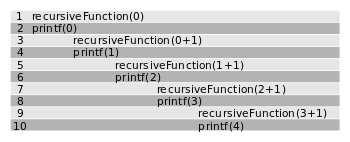
Function 2 [edit]
void recursiveFunction ( int num ) { if ( num < four ) recursiveFunction ( num + 1 ); printf ( "%d \n " , num ); } 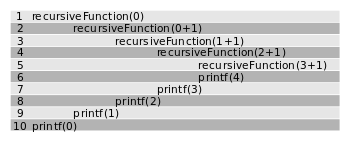
Office ii is function 1 with the lines swapped.
In the case of a function calling itself simply in one case, instructions placed earlier the recursive call are executed once per recursion before whatsoever of the instructions placed after the recursive call. The latter are executed repeatedly after the maximum recursion has been reached.
Also note that the order of the print statements is reversed, which is due to the way the functions and statements are stored on the call stack.
Recursive procedures [edit]
Factorial [edit]
A classic example of a recursive procedure is the function used to calculate the factorial of a natural number:

| Pseudocode (recursive): |
|---|
office factorial is: |
The part can also be written as a recurrence relation:


This evaluation of the recurrence relation demonstrates the computation that would be performed in evaluating the pseudocode above:
| Computing the recurrence relation for northward = 4: |
|---|
biv = 4 × b3 = 4 × (3 × bii) = 4 × (3 × (2 × b1)) = iv × (three × (two × (1 × b0))) = four × (3 × (2 × (1 × 1))) = four × (3 × (2 × 1)) = 4 × (iii × 2) = 4 × half-dozen = 24 |
This factorial part can also exist described without using recursion by making utilise of the typical looping constructs plant in imperative programming languages:
| Pseudocode (iterative): |
|---|
function factorial is: |
The imperative code higher up is equivalent to this mathematical definition using an accumulator variable t :
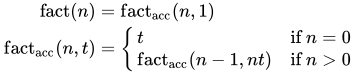
The definition above translates straightforwardly to functional programming languages such as Scheme; this is an example of iteration implemented recursively.
Greatest common divisor [edit]
The Euclidean algorithm, which computes the greatest mutual divisor of two integers, tin can exist written recursively.
Function definition:

| Pseudocode (recursive): |
|---|
part gcd is: input: integer ten, integer y such that 10 > 0 and y >= 0 |
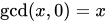
Recurrence relation for greatest mutual divisor, where expresses the remainder of :


- if


| Calculating the recurrence relation for ten = 27 and y = ix: |
|---|
gcd(27, ix) = gcd(9, 27 % 9) = gcd(9, 0) = 9 |
| Computing the recurrence relation for ten = 111 and y = 259: |
gcd(111, 259) = gcd(259, 111 % 259) = gcd(259, 111) = gcd(111, 259 % 111) = gcd(111, 37) = gcd(37, 111 % 37) = gcd(37, 0) = 37 |
The recursive programme above is tail-recursive; it is equivalent to an iterative algorithm, and the ciphering shown above shows the steps of evaluation that would be performed by a language that eliminates tail calls. Below is a version of the aforementioned algorithm using explicit iteration, suitable for a language that does not eliminate tail calls. By maintaining its state entirely in the variables x and y and using a looping construct, the program avoids making recursive calls and growing the telephone call stack.
| Pseudocode (iterative): |
|---|
function gcd is: |
The iterative algorithm requires a temporary variable, and even given knowledge of the Euclidean algorithm it is more hard to sympathise the process past simple inspection, although the 2 algorithms are very similar in their steps.
Towers of Hanoi [edit]

The Towers of Hanoi is a mathematical puzzle whose solution illustrates recursion.[24] [25] There are three pegs which can agree stacks of disks of different diameters. A larger disk may never be stacked on summit of a smaller. Starting with n disks on one peg, they must be moved to another peg one at a fourth dimension. What is the smallest number of steps to motion the stack?
Role definition:

Recurrence relation for hanoi:


| Computing the recurrence relation for n = iv: |
|---|
hanoi(iv) = 2×hanoi(three) + one = 2×(2×hanoi(2) + 1) + 1 = 2×(2×(2×hanoi(1) + 1) + 1) + 1 = 2×(2×(2×one + ane) + one) + 1 = 2×(ii×(3) + ane) + 1 = 2×(7) + 1 = fifteen |
Instance implementations:
| Pseudocode (recursive): |
|---|
function hanoi is: |
Although non all recursive functions have an explicit solution, the Tower of Hanoi sequence tin can be reduced to an explicit formula.[26]
| An explicit formula for Towers of Hanoi: |
|---|
h1 = one = 21 - 1 h2 = 3 = 22 - 1 h3 = vii = 2iii - 1 h4 = 15 = 24 - ane h5 = 31 = iifive - 1 h6 = 63 = 26 - one h7 = 127 = twovii - one In general: hn = 2n - 1, for all due north >= i |
Binary search [edit]
The binary search algorithm is a method of searching a sorted array for a single element past cutting the array in one-half with each recursive laissez passer. The play tricks is to selection a midpoint near the center of the assortment, compare the data at that signal with the data being searched and then responding to one of 3 possible conditions: the information is institute at the midpoint, the data at the midpoint is greater than the data beingness searched for, or the data at the midpoint is less than the information existence searched for.
Recursion is used in this algorithm because with each laissez passer a new array is created by cut the old one in one-half. The binary search procedure is then called recursively, this time on the new (and smaller) array. Typically the array's size is adjusted by manipulating a start and ending alphabetize. The algorithm exhibits a logarithmic order of growth considering it essentially divides the trouble domain in one-half with each pass.
Example implementation of binary search in C:
/* Call binary_search with proper initial conditions. INPUT: data is an array of integers SORTED in ASCENDING order, toFind is the integer to search for, count is the total number of elements in the array OUTPUT: consequence of binary_search */ int search ( int * information , int toFind , int count ) { // Get-go = 0 (beginning index) // End = count - i (top index) return binary_search ( data , toFind , 0 , count -one ); } /* Binary Search Algorithm. INPUT: data is a array of integers SORTED in ASCENDING social club, toFind is the integer to search for, start is the minimum array index, end is the maximum array index OUTPUT: position of the integer toFind within array information, -1 if non plant */ int binary_search ( int * data , int toFind , int showtime , int stop ) { //Get the midpoint. int mid = start + ( finish - first ) / 2 ; //Integer division if ( start > end ) //Stop status (base of operations instance) render -ane ; else if ( data [ mid ] == toFind ) //Establish, return alphabetize render mid ; else if ( information [ mid ] > toFind ) //Information is greater than toFind, search lower half return binary_search ( data , toFind , start , mid -1 ); else //Data is less than toFind, search upper one-half return binary_search ( data , toFind , mid + 1 , end ); } Recursive data structures (structural recursion) [edit]
An important awarding of recursion in calculator science is in defining dynamic information structures such every bit lists and copse. Recursive data structures can dynamically abound to a theoretically infinite size in response to runtime requirements; in dissimilarity, the size of a static array must be set at compile time.
"Recursive algorithms are particularly appropriate when the underlying problem or the data to exist treated are defined in recursive terms."[27]
The examples in this section illustrate what is known every bit "structural recursion". This term refers to the fact that the recursive procedures are acting on data that is divers recursively.
Equally long as a programmer derives the template from a information definition, functions use structural recursion. That is, the recursions in a function's body swallow some firsthand piece of a given compound value.[vii]
Linked lists [edit]
Below is a C definition of a linked list node construction. Notice especially how the node is defined in terms of itself. The "adjacent" element of struct node is a pointer to another struct node, effectively creating a listing type.
struct node { int data ; // some integer data struct node * adjacent ; // pointer to another struct node }; Because the struct node data structure is defined recursively, procedures that operate on it tin can exist implemented naturally as recursive procedures. The list_print procedure divers below walks down the listing until the list is empty (i.eastward., the list pointer has a value of Zero). For each node it prints the data element (an integer). In the C implementation, the listing remains unchanged by the list_print procedure.
void list_print ( struct node * list ) { if ( list != Nil ) // base of operations example { printf ( "%d " , list -> data ); // impress integer information followed by a infinite list_print ( list -> next ); // recursive call on the next node } } Binary trees [edit]
Below is a simple definition for a binary tree node. Like the node for linked lists, it is defined in terms of itself, recursively. At that place are two self-referential pointers: left (pointing to the left sub-tree) and right (pointing to the right sub-tree).
struct node { int data ; // some integer data struct node * left ; // pointer to the left subtree struct node * right ; // point to the right subtree }; Operations on the tree tin can exist implemented using recursion. Note that because there are ii self-referencing pointers (left and correct), tree operations may require ii recursive calls:
// Test if tree_node contains i; return 1 if and then, 0 if not. int tree_contains ( struct node * tree_node , int i ) { if ( tree_node == NULL ) return 0 ; // base case else if ( tree_node -> data == i ) return 1 ; else return tree_contains ( tree_node -> left , i ) || tree_contains ( tree_node -> right , i ); } At most two recursive calls volition exist made for any given call to tree_contains every bit defined to a higher place.
// Inorder traversal: void tree_print ( struct node * tree_node ) { if ( tree_node != NULL ) { // base of operations case tree_print ( tree_node -> left ); // go left printf ( "%d " , tree_node -> data ); // print the integer followed by a infinite tree_print ( tree_node -> right ); // get right } } The in a higher place example illustrates an in-club traversal of the binary tree. A Binary search tree is a special case of the binary tree where the data elements of each node are in gild.
Filesystem traversal [edit]
Since the number of files in a filesystem may vary, recursion is the merely practical manner to traverse and thus enumerate its contents. Traversing a filesystem is very similar to that of tree traversal, therefore the concepts behind tree traversal are applicative to traversing a filesystem. More than specifically, the code below would be an case of a preorder traversal of a filesystem.
import java.io.File ; public class FileSystem { public static void master ( String [] args ) { traverse (); } /** * Obtains the filesystem roots * Gain with the recursive filesystem traversal */ private static void traverse () { File [] fs = File . listRoots (); for ( int i = 0 ; i < fs . length ; i ++ ) { Organisation . out . println ( fs [ i ] ); if ( fs [ i ] . isDirectory () && fs [ i ] . canRead ()) { rtraverse ( fs [ i ] ); } } } /** * Recursively traverse a given directory * * @param fd indicates the starting point of traversal */ individual static void rtraverse ( File fd ) { File [] fss = fd . listFiles (); for ( int i = 0 ; i < fss . length ; i ++ ) { System . out . println ( fss [ i ] ); if ( fss [ i ] . isDirectory () && fss [ i ] . canRead ()) { rtraverse ( fss [ i ] ); } } } } This lawmaking is both recursion and iteration - the files and directories are iterated, and each directory is opened recursively.
The "rtraverse" method is an case of direct recursion, whilst the "traverse" method is a wrapper function.
The "base case" scenario is that at that place will always be a fixed number of files and/or directories in a given filesystem.
Time-efficiency of recursive algorithms [edit]
The time efficiency of recursive algorithms can be expressed in a recurrence relation of Large O note. They tin (usually) then be simplified into a single Big-O term.
Shortcut dominion (main theorem) [edit]
If the time-complexity of the function is in the form

Then the Large O of the fourth dimension-complexity is thus:
where a represents the number of recursive calls at each level of recursion, b represents by what factor smaller the input is for the side by side level of recursion (i.eastward. the number of pieces you lot divide the problem into), and f(n) represents the piece of work that the part does independently of any recursion (east.k. partitioning, recombining) at each level of recursion.
See also [edit]
- Functional programming
- Computational problem
- Hierarchical and recursive queries in SQL
- Kleene–Rosser paradox
- Open recursion
- Recursion
- Sierpiński curve
- McCarthy 91 function
- μ-recursive functions
- Archaic recursive functions
- Tak (function)
Notes [edit]
- ^ Graham, Ronald; Knuth, Donald; Patashnik, Oren (1990). "ane: Recurrent Problems". Concrete Mathematics. ISBN0-201-55802-v.
- ^ Kuhail, Thou. A.; Negreiros, J.; Seffah, A. (2021). "Education Recursive Thinking using Unplugged Activities" (PDF). WTE&TE. 19: 169–175.
- ^ Epp, Susanna (1995). Discrete Mathematics with Applications (2d ed.). p. 427. ISBN978-0-53494446-9.
- ^ Wirth, Niklaus (1976). Algorithms + Data Structures = Programs. Prentice-Hall. p. 126. ISBN978-0-13022418-7.
- ^ "Functional Programming | Clojure for the Brave and True". world wide web.braveclojure.com . Retrieved 2020-10-21 .
- ^ Felleisen et al. 2001, art 5 "Generative Recursion
- ^ a b Felleisen, Matthias (2002). "Developing Interactive Web Programs". In Jeuring, Johan (ed.). Advanced Functional Programming: 4th International School (PDF). Springer. p. 108. ISBN9783540448334.
- ^ Mongan, John; Giguère, Eric; Kindler, Noah (2013). Programming Interviews Exposed: Secrets to Landing Your Adjacent Chore (tertiary ed.). Wiley. p. 115. ISBN978-1-118-26136-1.
- ^ Hetland, Magnus Lie (2010), Python Algorithms: Mastering Basic Algorithms in the Python Language, Apress, p. 79, ISBN9781430232384 .
- ^ Drozdek, Adam (2012), Information Structures and Algorithms in C++ (4th ed.), Cengage Learning, p. 197, ISBN9781285415017 .
- ^ Shivers, Olin. "The Anatomy of a Loop - A story of telescopic and control" (PDF). Georgia Establish of Engineering science. Retrieved 2012-09-03 .
- ^ Lambda the Ultimate. "The Anatomy of a Loop". Lambda the Ultimate. Retrieved 2012-09-03 .
- ^ "27.1. sys — System-specific parameters and functions — Python v2.vii.3 documentation". Docs.python.org. Retrieved 2012-09-03 .
- ^ Krauss, Kirk J. (2014). "Matching Wildcards: An Empirical Way to Tame an Algorithm". Dr. Dobb'south Journal.
- ^ Mueller, Oliver (2012). "Anatomy of a Stack Bang-up Attack and How GCC Prevents It". Dr. Dobb's Journal.
- ^ "StackOverflowException Grade". .NET Framework Class Library. Microsoft Developer Network. 2018.
- ^ "Depth Start Search (DFS): Iterative and Recursive Implementation". Techie Please. 2018.
- ^ Mitrovic, Ivan. "Replace Recursion with Iteration". ThoughtWorks.
- ^ La, Woong Gyu (2015). "How to supplant recursive functions using stack and while-loop to avoid the stack-overflow". CodeProject.
- ^ Moertel, Tom (2013). "Tricks of the merchandise: Recursion to Iteration, Part 2: Eliminating Recursion with the Time-Traveling Secret Feature Fox".
- ^ Salz, Rich (1991). "wildmat.c". GitHub.
- ^ Krauss, Kirk J. (2008). "Matching Wildcards: An Algorithm". Dr. Dobb's Journal.
- ^ Krauss, Kirk J. (2018). "Matching Wildcards: An Improved Algorithm for Big Data". Develop for Performance.
- ^ Graham, Knuth & Patashnik 1990, §1.ane: The Belfry of Hanoi
- ^ Epp 1995, pp. 427–430: The Tower of Hanoi
- ^ Epp 1995, pp. 447–448: An Explicit Formula for the Belfry of Hanoi Sequence
- ^ Wirth 1976, p. 127
References [edit]
- Barron, David William (1968) [1967]. Written at Cambridge, Uk. Gill, Stanley (ed.). Recursive techniques in programming. Macdonald Computer Monographs (1 ed.). London, UK: Macdonald & Co. (Publishers) Ltd. SBN356-02201-iii. (viii+64 pages)
- Felleisen, Matthias; Findler, Robert B.; Flatt, Matthew; Krishnamurthi, Shriram (2001). How To Design Programs: An Introduction to Computing and Programming. MIT Press. ISBN0262062186.
- Rubio-Sanchez, Manuel (2017). Introduction to Recursive Programming. CRC Printing. ISBN978-1-351-64717-5.
- Pevac, Irena (2016). Practicing Recursion in Java. CreateSpace Independent. ISBN978-i-5327-1227-2.
- Roberts, Eric (2005). Thinking Recursively with Java. Wiley. ISBN978-0-47170146-0.
- Rohl, Jeffrey S. (1984). Recursion Via Pascal. Cambridge Academy Press. ISBN978-0-521-26934-6.
- Helman, Paul; Veroff, Robert. Walls and Mirrors.
- Abelson, Harold; Sussman, Gerald Jay; Sussman, Julie (1996). Construction and Interpretation of Computer Programs (second ed.). MIT Printing. ISBN0-262-51087-i.
- Dijkstra, Edsger W. (1960). "Recursive Programming". Numerische Mathematik. 2 (1): 312–318. doi:10.1007/BF01386232. S2CID 127891023.
rodriguezruitheroming51.blogspot.com
Source: https://en.wikipedia.org/wiki/Recursion_%28computer_science%29
0 Response to "In a Recursive Function the Statement S That Invoke the Function Again Are Called the"
Post a Comment