1 What Accounts for the Prevalence of Female Figures in Paleolithic Art?
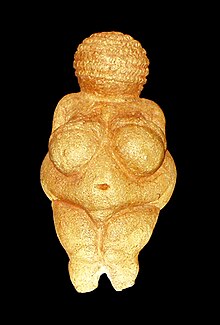
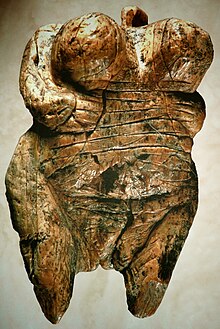
A Venus figurine is whatever Upper Palaeolithic statuette portraying a woman, usually carved in the round.[1] Virtually have been unearthed in Europe, simply others accept been found as far away every bit Siberia, and distributed across much of Eurasia.
Most engagement from the Gravettian menstruum (26,000–21,000 years agone).[1] However, findings are not limited to this period; for example, the Venus of Hohle Fels dates back at to the lowest degree 35,000 years to the Aurignacian era, and the Venus of Monruz dates back about 11,000 years to the Magdalenian. Such figurines were carved from soft stone (such as steatite, calcite or limestone), bone or ivory, or formed of clay and fired. The latter are among the oldest ceramics known to historians. In total, over 200 such figurines are known;[2] virtually all of pocket-sized size, between near 3 and 40 cm (1.2 and fifteen.seven in) in height.[3] These figurines are recognised as some of the earliest works of prehistoric art.
Most have broad hips and legs that taper to a point. Arms and feet are often absent, and the head is usually small and faceless. Various figurines exaggerate the abdomen, hips, breasts, thighs, or vulva, although many found examples do non reflect these typical characteristics. Depictions of hairstyles can be detailed, and particularly in Siberian examples, clothing or tattoos may exist indicated.[four]
The original cultural meaning and purpose of these artefacts is non known. It has frequently been suggested that they may take served a ritual or symbolic part. There are widely varying and speculative interpretations of their use or meaning: they accept been seen as religious figures,[v] an expression of health and fertility, grandmother goddesses, or equally self-depictions past female artists.[6]
History of discovery [edit]
The Vénus impudique, which was the figurine that gave the whole category its name, was the first Palaeolithic sculptural representation of a adult female to be discovered in modern times. Information technology was found in 1864 by Paul Hurault, 8th Marquis de Vibraye at Laugerie-Basse in the Vézère valley. This valley is i of the many of import Stone Age sites in and around the commune of Les Eyzies-de-Tayac-Sireuil in Dordogne, southwestern France. The figurines were generally discovered in settlement contexts, both in open-air sites and caves.[1] The Magdalenian Venus from Laugerie-Basse is headless, footless, armless, and displays a strongly emphasised female reproductive system.[7]
Four years later, Salomon Reinach published an article nigh a group of soapstone figurines from the caves of Balzi Rossi. The famous Venus of Willendorf was excavated in 1908 from a loess deposit in the Danube valley located in Austria. Since and then, hundreds of similar figurines have been discovered from the Pyrenees Mountains to the plains of Siberia.[ citation needed ]
In September 2008, archaeologists from the University of Tübingen discovered a 6 cm (2.4 in) figurine carved from a mammoth'southward tusk. This figurine was later called the Venus of Hohle Fels and tin exist dated to at least 35,000 years agone. It represents the primeval known sculpture of this type and the earliest known work of figurative art.[8]
Proper noun [edit]
Upper Palaeolithic female figurines are collectively described as "Venus figurines" in reference to the Roman goddess of beauty Venus. The name was offset used in the mid-nineteenth century past the Marquis de Vibraye, who discovered an ivory figurine and named it La Vénus impudique or Venus Impudica ("immodest Venus").[ix] The Marquis so contrasted the ivory figurine to the Aphrodite Of Knidos, a Greco-Roman sculpture depicting Venus covering her naked torso with both her hands.[9] In the early 20th century, the general belief among scholars was that the figurines represent an ancient ideal of beauty. Since their discovery, considerable diversity in opinion amidst archeologists and in paleoanthropological literature has arisen every bit to the part and significance of the figures.[x] Virtually scholars that have differing opinions on the purpose of the figurines, such as anthropologist Randall White, besides disapprove of the "Venus" name as a event.[11]
The apply of the name is metaphorical every bit there is no link between the ancient figurines and the Roman goddess Venus; although they have been interpreted as representations of a primordial female goddess. This perception is said to accept derived from the fact that attending is directed to certain features common to most of the figurines. In particular, emotionally charged primary and secondary sexual characteristics, such as, the breasts, stomachs and buttocks.[12] The term has been criticised for existence a reflection of modern Western ideas rather than reflecting the beliefs of the sculptures' original owners, merely the original names are unknown every bit well, so the term Venus has persisted.[13]
Like many prehistoric artefacts, the exact cultural pregnant of these figures may never be known. Archaeologists speculate, however, that they may be symbolic of security and success, fertility, or a mother goddess.[xiv] The female figures are a office of Upper Palaeolithic fine art, specifically the category of Palaeolithic art known every bit portable fine art.
Figure details [edit]
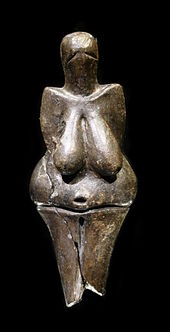
The majority of Venus figurines are depictions of women, and follow artistic conventions of the times. About of the figurines display the same body shape with the widest indicate at the abdomen and the female person reproductive organs exaggerated. Oftentimes other details, such equally the head and limbs, are neglected or absent which leads the figure to be abstracted to the point of simplicity. The heads are often of relatively minor size and devoid of detail. Some may represent significant women, while others show no indication of pregnancy.[16]
The Venus of Willendorf and the Venus of Laussel (a stone relief rather than a figurine) bear traces of having been externally covered in cerise ochre. The significance of this is non articulate, simply is traditionally assumed to be religious or ritual in nature. Some homo bodies from the Palaeolithic era are found similarly covered, so information technology is assumed this color had a significant meaning in their civilization even though we exercise not know what.[17]
All more often than not accepted Palaeolithic female figurines are from the Upper Palaeolithic. Although they were originally mostly considered part of the Aurignacian culture, the majority are at present associated with the Gravettian and Solutrean cultures.[18] In these periods, the more rotund figurines are predominant. Within the Magdalenian cultures, the forms become effectively with more detail and the styling of said figures started to become similar within areas of close contact.[ citation needed ]
Estimation [edit]

Despite being thought equally one of the most 'fertile sources of contend in all of archæology', Venus figurines appear to be relatively unstudied as a whole.[xi] The consequences of this is that they have fallen victim to generalised stereotypes that neglect to admit morphological variation and differing contexts.[xi]
Nevertheless, there has still been many differing interpretations of the figurines since their discovery[ane] - one of which comes from Helen Benigni. In her book, Emergence of the Goddess, she argues that the consistency in design of these characterless, large-breasted, often meaning figures throughout a wide region and over a long menstruation of time suggests they represent an classic of a female Supreme Creator. Neolithic, Bronze Age, and Iron Age inhabitants likely connected women as creators innately tied to the cycles of nature. Through this, information technology was believed that women's nativity and menstrual cycles aligned with lunar cycles and tides.[xix]
One interpretation came from McCoid and McDermott who suggested that because of the manner these figures are depicted, such as the large breasts and lack of feet and faces, these statues were made by women looking at their own bodies. They suggest that women during the period would not take had access to mirrors to maintain authentic proportions. This theory also provides an explanation every bit to why many of the Venus figures do non have faces or heads, every bit the creators would need mirrors to do so. However, Michael Southward. Bisson critiqued this theory by suggesting that alternatives, such as puddles, could accept been used every bit mirrors.[xx]
It has been suggested that they may be a sign of an earlier prevalence of steatopygia, now associated principally to women of certain African or Andamanese ancestry. All the same the Venuses practise not qualify as steatopygian, since they exhibit an angle of approximately 120 degrees betwixt the back and the buttocks, while steatopygia is diagnosed past modern medical standards at an bending of most 90 degrees only.[21]
Another modern estimation, providing an explanation for visible weight diverseness amongst the figurines, comes from Johnson et al.[22] Hither, they argue that differences in the statues tin be said to relate to human adaption to climate change. This is because figurines that are seen to exist obese or meaning originate to the earlier fine art from 38,000 to xiv,000 BP - a menstruum where nutritional stress arose as a result of falling temperatures.[22] Accordingly, they establish a correlation betwixt an increase in distance from glacial fronts and a decrease in obesity of the figurines. This was justified every bit survival and reproduction, in glacial, colder areas, required sufficient diet and, consequently, over-nourished woman may have been seen as the platonic of dazzler in these areas.[22]
Subsequently female figurines and continuity [edit]
All part of the Neolithic 'Venus figurines' tradition, the arable breasts and hips of these figurines suggest links to fertility and procreation.
Some scholars suggest a direct continuity between Palaeolithic female figurines and later on examples of female depictions from the Neolithic or Bronze Age.[25]
A female person figurine which has 'no practical use and is portable' and has the common elements of a Venus figurine (a strong accent or exaggeration of female sex linked traits, and the lack of complete lower limbs) may be considered to be a Venus figurine, even if archaeological evidence suggests it was produced after the main Palaeolithic menses. Some figurines matching this definition originate from the Neolithic era and into the Bronze Age. The flow and location in which a figurine was produced helps guide archaeologists to accomplish conclusions as to whether the art slice found can exist divers every bit a Venus figurine or non. For example, ceramic figurines from the late ceramic Neolithic may be accepted every bit Venus figurines, while stone figurines from afterwards periods are not. This is a matter of ongoing fence given the strong similarity between many figurines from the Palaeolithic, Neolithic and beyond. A reworked endocast of a brachiopod from around 6000 BCE in Kingdom of norway has been identified as a belatedly Venus figurine.[26]
This means that a given female figurine may or may not be classified as a Venus figure by whatever given archaeologist, regardless of its engagement, though most archaeologists disqualify figurines which date later than the Palaeolithic, even though their purpose could have been the aforementioned.[ citation needed ]
Notable figurines [edit]
| Proper noun | Age (approx.) | Location | Textile |
|---|---|---|---|
| Venus of Tan-Tan (disputed) | 300,000–500,000 | Tan-Tan, Kingdom of morocco | Quartzite |
| Venus of Berekhat Ram (disputed) | 230,000–280,000 | Lake Ram, Golan Heights | Scoria |
| Venus of Hohle Fels | 35,000–40,000 | Swabian Alb, Germany | mammoth ivory |
| Venus of Galgenberg | thirty,000 | Lower Republic of austria | serpentine rock |
| Venus of Dolní Věstonice | 27,000–31,000 | Moravia, Czechia | ceramic |
| Venus of Mauern | 27,000 | Mauern, Germany | limestone |
| Venus of Laussel | 25,000 | Southern French republic | limestone, but a relief |
| Venus of Lespugue | 24,000–26,000 | French Pyrenees | ivory |
| Venus of Willendorf | 24,000–26,000 | Lower Austria | limestone |
| Venus of Brassempouy | 23,000–25,000 | Brassempouy, France | ivory |
| Venus of Petřkovice | 23,000 | Silesia, Czech Republic | hematite |
| Venus figurines of Mal'ta | 23,000 | Irkutsk Oblast, Russia | ivory |
| Venuses of Buret' | 20,000–21,000 | Irkutsk Oblast, Russia | ivory, serpentine rock |
| Venus of Moravany | 23,000 | Moravany nad Váhom, Slovakia | mammoth ivory |
| Venus figurines of Kostenki | xx,000–25,000 | Kostyonki–Borshchyovo, Russia | ivory |
| Venus of Savignano | 20,000–25,000 | Savignano sul Panaro, Italian republic | serpentine rock |
| Venus figurines of Gagarino | 20,000–21,000 | Lipetsk Oblast, Russia | ivory |
| Venus figurines of Balzi Rossi | 18,000–25,000 | Ventimiglia, Italy | ivory, soapstone, serpentine, chlorite |
| Vénus impudique | sixteen,000 | Laugerie-Basse, France | ivory |
| Venus of Waldstetten | 15,000 | Waldstetten, Germany | Quartzite |
| Venus of Eliseevichi | 15,000 | Bryansk, Russia | ivory |
| Venus figurines of Zaraysk | xiv,000–20,000 | Zaraysk, Russia | ivory |
| Venus figurines of Gönnersdorf | 11,500–15,000 | Neuwied, Germany | ivory, antler, os |
| Venus figurines of Petersfels | 11,500–xv,000 | Engen, Germany | black jet |
| Venus of Monruz | 11,000 | Neuchâtel, Switzerland | blackness jet |
See also [edit]
- List of Stone Historic period fine art
- Matriarchal religion
- When God Was A Adult female
- Feminine beauty ideal
Notes [edit]
- ^ a b c d Fagan, Brian Chiliad., Beck, Charlotte, "Venus Figurines", The Oxford Companion to Archaeology, 1996, Oxford Academy Press, ISBN 9780195076189 pp. 740–741
- ^ Holloway
- ^ Fagan, 740
- ^ "Clothing of figurines may be tape of Ice Age tribes' skills". one-time.post-gazette.com . Retrieved 2019-11-13 .
- ^ Beck, 207-208
- ^ William Haviland, Harald Prins, Dana Walrath, Bunny McBride, Anthropology: The Human Claiming, 13th edition, 2010, Cengage Learning, ISBN 0495810843, 9780495810841,google books; Cook; Brook, 205-208
- ^ White, Randall (December 2008). "The Women of Brassempouy: A Century of Inquiry and Interpretation" (PDF). Journal of Archaeological Method and Theory. xiii (4): 250–303. doi:10.1007/s10816-006-9023-z. S2CID 161276973.
- ^ Cressey, Daniel (13 May 2009). "Aboriginal Venus rewrites history books". Nature. News. doi:10.1038/news.2009.473.
- ^ a b Beck, 202-203
- ^ Dixson, Alan F.; Dixson, Barnaby J. (2012-01-03). "Venus Figurines of the European Paleolithic: Symbols of Fertility or Bewitchery?". Journal of Anthropology. 2011: i–xi. doi:ten.1155/2011/569120.
- ^ a b c White, Randall (2006-11-30). "The Women of Brassempouy: A Century of Research and Estimation". Journal of Archaeological Method and Theory. 13 (4): 250–303. doi:ten.1007/s10816-006-9023-z. ISSN 1072-5369. S2CID 161276973.
- ^ Soffer, O.; Adovasio, J. M.; Hyland, D. C. (2000-08-01). "The "Venus" Figurines: Textiles, Basketry, Gender, and Status in the Upper Paleolithic". Current Anthropology. 41 (4): 511–537. doi:10.1086/317381. ISSN 0011-3204. S2CID 162026727.
- ^ Dr. Beth Harris & Dr. Steven Zucker (27 May 2012). Nude Woman (Venus of Willendorf), c. 28,000-25,000 B.C.Due east. (youtube video). Smarthistory, Art History at Khan Academy. Issue occurs at 0:21. Archived from the original on 2021-11-17. Retrieved 1 June 2015.
- ^ Soffer, O.; Adovasio, J. Yard.; Hyland, D. C. (Summertime 2000). "The "Venus" Figurines: Textiles, Basketry, Gender, and Status in the Upper Paleolithic". Current Anthropology. 41 (4): 511–537. doi:x.1086/317381. ISSN 0011-3204. S2CID 162026727.
- ^ The trunk used is the local loess, with only traces of clay; in that location is no trace of surface burnishing or practical pigment. Vandiver, P. B.; Soffer, O.; Klima, B.; Svoboda, J. (1989). "The Origins of Ceramic Technology at Dolni Vestonice, Czechoslovakia". Science. 246 (4933): 1002–1008. Bibcode:1989Sci...246.1002V. doi:10.1126/science.246.4933.1002. PMID 17806391. S2CID 138977052.
- ^ Sandars, 29; Fagan, 740-741; Cook; Beck, 203-213, who analyses attempts to classify the figures.
- ^ Sandars, 28
- ^ Fagan, 740-741; Beck, 203
- ^ Benigni, Helen, ed. 2013. The Mythology of Venus: Ancient Calendars and Archaeoastronomy. Lanham, Maryland : Academy Press of America.
- ^ McDermott, Leroy (1996). "Self-Representation in Upper Paleolithic Female person Figurines". Electric current Anthropology. 37 (2): 227–275. doi:x.1086/204491. JSTOR 2744349. S2CID 144914396.
- ^ Softpedia, Stefan Anitei (4 Apr 2007). "What is Steatopygia?". news.softpedia.com/ . Retrieved 4 September 2016.
- ^ a b c Johnson, Richard J (1 December 2020). "Upper Paleolithic Figurines Showing Women with Obesity may Represent Survival Symbols of Climate change". Obesity a Research Journal. 29 (i): 11–xv. doi:10.1002/oby.23028. PMC7902358. PMID 33258218.
- ^ "Site officiel du musée du Louvre". cartelfr.louvre.fr.
- ^ "Effigy féminine - Les Musées Barbier-Mueller". www.musee-barbier-mueller.org.
- ^ Walter Burkert, Homo Necans (1972) 1983:78, with extensive bibliography, including P.J. Ucko, who contested the identification with mother goddesses and argues for a plurality of meanings, in Anthropomorphic Figurines of Predynastic Egypt and Neolithic Crete with Comparative Textile from the Prehistoric Well-nigh East and Mainland Greece (1968).
- ^ Tidemann, Grethe. "Venus fra Svinesund". Uniforum. University of Oslo. Retrieved 11 Dec 2014.
References [edit]
- Brook, Margaret, in Ratman, Alison E. (ed.), Reading the Trunk: Representations and Remains in the Archaeological Record, 2000, University of Pennsylvania Press, ISBN 0812217098, 9780812217094, google books
- Cook, Jill, Venus figurines, Video with Dr Jill Cook, Curator of European Prehistory, British Museum
- Fagan, Brian G., Brook, Charlotte, "Venus Figurines", The Oxford Companion to Archaeology, 1996, Oxford Academy Press, ISBN 0195076184, 9780195076189, google books
- Sandars, Nancy Thousand. (1968), Prehistoric Fine art in Europe. Penguin: Pelican, at present Yale, History of Art. (nb 1st ed.)
Further reading [edit]
- Abramova, Z. (1962). Paleolitičeskoe iskusstvo na territorii SSSR, Moskva : Akad. Nauk SSSR, Inst. Archeologii
- Abramova, Z. (1995). L'Fine art paléolithique d'Europe orientale et de Sibérie., Grenoble: Jérôme Millon.
- Cohen, C. (2003). La femme des origines - images de la femme dans la préhistoire occidentale, Belin - Herscher. ISBN ii-7335-0336-7
- Conard, Nicholas J. (2009). "A female figurine from the basal Aurignacian of Hohle Fels Cavern in southwestern Germany". Nature. 459 (7244): 248–252. Bibcode:2009Natur.459..248C. doi:10.1038/nature07995. PMID 19444215. S2CID 205216692.
- Melt, Jill. (2013). Water ice Historic period Art: the Arrival of the Modern Mind; London: British Museum Printing. ISBN 978-0-7141-2333-2
- Delporte, Henri. (1993). Fifty'image de la femme dans l'art préhistorique, éd. Picard. (ISBN 2-7084-0440-vii)
- Dixson, Alan F.; Dixson, Barnaby J. (2011). "Venus Figurines of the European Paleolithic: Symbols of Fertility or Attractiveness?". Journal of Anthropology. 2011: 1–xi. doi:x.1155/2011/569120.
- Gvozdover, Thou. (1995).: Art of the mammoth hunters: the finds from Avdeevo, (Oxbow Monograph 49), Oxford: Oxbow.
- Power, C. (2004). "Women in prehistoric fine art". In G. Berghaus (ed.), New Perspectives in Prehistoric Art. Westport, CT & London: Praeger, pp. 75–104.
- Schlesier/, Karl H.; Soffer, O.; Adovasio, J. M.; Hyland, and D. C. (2001). "More on the "Venus" Figurines". Electric current Anthropology. 42 (3): 410–412. doi:10.1086/320478. S2CID 162218369.
- Soffer, O.; Adovasio, J. Grand.; Hyland, D. C. (2000). "The "Venus" Figurines". Electric current Anthropology. 41 (4): 511–537. doi:10.1086/317381. S2CID 162026727.
- Rau, S., Naumann D., Barth M., Mühleis Y., Bleckmann C. (2009): Eiszeit: Kunst und Kultur, Thorbecke. ISBN 978-3-7995-0833-9
External links [edit]
- Venus figures from the Stone Historic period - with fantabulous pictures of near of the figurines
- Undergraduate thesis, University of Texas, PDF
- Christopher Witcombe, "Analysis of the Venus of Willendorf"
- (Canadian Museum of Civilization) The Balzi Rossi Figurines
rodriguezruitheroming51.blogspot.com
Source: https://en.wikipedia.org/wiki/Venus_figurine
0 Response to "1 What Accounts for the Prevalence of Female Figures in Paleolithic Art?"
Post a Comment